As athletes, we often focus on the physical demands of our sport. Yet, ask any athlete, of any sport, and they’ll tell you, the mental game is equally crucial and challenging. This is especially true in the world of equestrian sports as our mindset not only impacts our own performance but can permeate to our partner as well. A partner who relies on our body language and energy to truly understand their surroundings.
The balance between talent and skill in the irons, with mental resilience and our ability to manage our emotions will often make the difference between a good day in the ring and a great one.
Today, I want to present a powerful experiment that represents one of my FAVOURITE topics when it comes to performance and moving the dial in our ability to achieve our greatest dreams; shifting the focus from results to the process.
The Challenge: A Fact-Finding Mission
Here’s the challenge I have for you—or if you prefer, a bit of an experiment to try at your next horse show. Instead of fixating on specific results you’re hoping to achieve, approach the event as a Fact Finding Mission guided by four powerful questions.
If you’re asking; why would I want to take my focus off the prize?
I ask because I promise that uncovering the answers to these questions will accelerate your progress and help you reach further than you ever expected. Me.. and a whole bunch of sports psychologist, high-performance experts and other qualified scientists..
Are you ready?
Let the experiment begin!
The Four Questions
For best results: Actually writing (or I suppose typing at the very least) these reflections can significantly improve your results.
At the end of each day:
1. What went well today?
Look at your day from the moment you opened your eyes. Examine in detail what aspects of the day went positively.
Examples:
- “I was up and out of the house with ease because my bag was packed and sitting at the front door”
- “I arrived at the show with time to spare and settle before riding.”
- “I LOVE the early morning drives to the show with my hot coffee and watching the sunrise”
- “I learned my course before I even got on and knew it before arriving at the in-gate.”
- “I accidentally showed up to the in-gate with five horses ahead of me, but it gave me extra time to collect my thoughts.”
- “I went for a long walk after my classes and it really helped me digest my rounds, and relax before getting back to the barn”
2. What did not go well today?
These are not criticisms or failures, these are simply observations of which parts of your day did not go as smoothly as you’d hoped, or you felt a change in your mental/emotional/physical state.
Examples:
- “My ring was running ahead of schedule and I had to rush to get on quickly”
- “The warm-up ring was really busy and I felt panicked and rushed in my warm-up.”
- “I didn’t like having to go back-to-back rounds; I needed a break between my trips.”
- “There were too many people talking to me before I went in the ring, and I couldn’t focus on my plan.”
- “It was a really long day and I ran out of gas by my last class”
At the end of the show:
3. What will I do more of next time?
This is where you begin to start recognizing positive behaviors in your day. By recognizing small actions that had a positive affect on you, you can begin to build your routines and rituals around repeating them.
Examples:
- “I liked having the extra time with my horse back at the barn before the day even starts.”
- “Watching the class ahead of me helped me focus and see how the course was riding.”
- “Doing a lot of walking before my warm-up felt good for both me and my horse.”
- “I had a groom to help me do stalls, feed and water. Even tho it was an added expense, it was a huge relief of time and pressure so I felt I could relax and enjoy the show more”
4. What will I stop doing?
This is where you’re going to acknowledge parts of your day that may not be serving you. This can be the most difficult task because it often requires some setting and communicating of boundaries.
Examples:
- “I’ll ask my friends and family to meet me at the ring when it’s time to tack up/get dressed so I can start to focus while back at the barns.”
- “I’ll remove myself from gossipy conversations as they don’t serve me.”
- “I’m going to stop looking up the results when I didn’t do as well as I’d hoped and compare myself to others who had a better day that day.”
- “I’m going to go home after the show day is done instead of going to the team dinner or out with friends. I really do need to decompress, rest and prepare for the next day.”
Breaking down your day, and show, into what went well helps you recognize progress, celebrate small victories, and boost your confidence. When you know what’s working, you can do more of it. Conversely, identifying what didn’t go well is the first step towards solving problems or making improvements.
Determining what you’ll stop doing altogether can feel like removing big obstacles blocking your path and allow the confidence and focus to flow freely! Shifting your focus in this way at your next show can bring more than just ribbons—it can lead to personal growth and more fulfillment from your horse show experience.
Embracing the power of your mindset will guide you to success in the ring and beyond.
So I challenge you; release your attachment to the results for just one show and focus your energy on answering these 4 simple questions. What you gain will be transformative, and I can promise you that the insights you gain, in the end, will bring you closer to the results to desire.
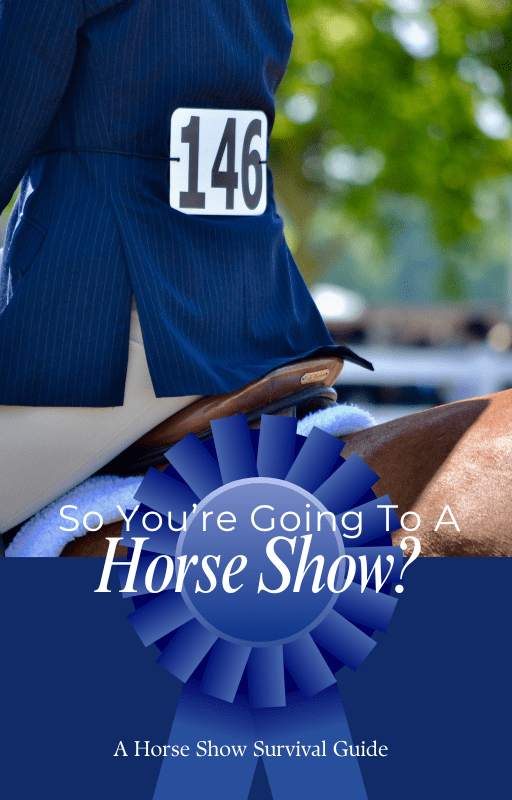
These 4 Simple Questions are a part of the Mindset Matters chapter in So You’re Going To A Horse Show? They are part of a bigger conversation around taking on the mental game at the horse show that includes developing a growth mindset, routines and rituals, goal setting and post-show reflection.
Other Posts You Might Like

How I Organize My Life As An Adult Amateur
Are you curious how it’s done? How we seem to ‘have it all’? Ride horses, have families, professional careers.. you know, how we’re “living the…
Keep reading
3 Reasons To Work With A Professional
Have you ever Googled “how to buy a horse” or “what to know before buying a horse”? If so, please—lovingly—step away from the keyboard. I…
Keep reading
5 Myths About Buying Horses That You Need to Stop Believing
So, you’re on the hunt for your dream horse, and everyone has advice to offer. But let me tell you – not all that advice…
Keep readingSomething went wrong. Please refresh the page and/or try again.
 Buying A Horse?